

 I had the pleasure of meeting an experienced and confident leadership coach friend of mine the other day when I had an appointment in her neck of the woods, Chapel Hill (an hour from my home). We were talking about the usual business… how AI is affecting our businesses, and what is motivating us lately to keep pushing on. I asked her if she watched Ted Lasso, and she said, “Oh hell yeah. I love Ted!”
I mentioned an episode I watched the other night from Season 4 where Ted presents a riddle to his coaching staff: “The more you take, the more you leave behind. What am I?” After a few comical guesses that included some potty humor, Ted responds, “FOOTSTEPS.”
 That devolved into a marketing discussion (of course), where we discussed the number of footsteps we have taken over the years and how we learned from each one. We have stepped on rocks and holes along the way, but we’ve turned them into knowledge and lessons that guide others through their business paths.
Then came the concept: “You can share those steps today to promote your business on the internet, but if people never see them, do those steps matter?” Social media is controlled by algorithms, and email is blocked by filters that flag perceived spam. Still, you have to forge ahead and step on rocks and through holes to get your messages to the people who need what you do.
What we ended up with is that sharing personal contact and references is our best way to help promote each other to people who may pay attention to all those footsteps taken and lessons learned along the way.
The Surveillance Economy
 We have been leaving footprints on the internet since the 1990s when we downloaded Netscape. They understood the game. Just like TV gave you free channels in exchange for your attention, Netscape gave you a free browser, and you paid them with your attention to look at ads. AOL saw the value when they bought your footsteps in 1999. Then Google created a better footstep trap, with better search results.
Although Google couldn’t tell whether my wife or I was browsing, it could track searches by our IP address.
Facebook took surveillance to a whole other level when it started tracking your footsteps (or eyeballs) and fed you more of what you liked through an algorithm. Now they knew I liked dogs, the Chicago Bears, and marketing people. It fed me more people to connect with and ads that matched my preferences.
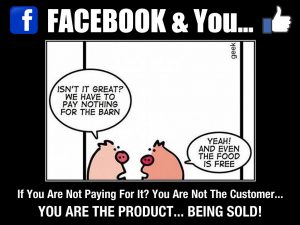
Back in 2015, Facebook sold our data to Cambridge Analytica, and they used some of it, along with voter records, to build profiles and targeted political messages. They were not just using your footsteps to show you ads, but to change your opinions and perspectives.
Now, Facebook has released MUSE, which is an AI agent that wants full access to your files and passwords. This, along with hacking, could expose your personal data and account to all kinds of nefarious uses.
AI Surveillance
 Using AI like Claude, ChatGPT, Gemini, and Muse may feel like an innocuous convenience, but it could also become a powerful surveillance tool.
It may seem normal to upload your customer list and ask AI to analyze it and give you similar companies to approach and market to, but that kind of business activity is simply training LLMs about your clients. (Something that it could share with your competition.)
Although the companies may talk about privacy, unless you have a closed-loop enterprise system, your data is being used to train their LLMs.
 You may feel like you pay $20 a month for privacy, but you’re really paying for more power while they collect your intelligence and data to sell as tokens and enterprise systems to big fish.
In other words, they trade you free or cheap AI to train their systems, then sell it for a profit without paying you for your intellectual property.
Keep that in mind, especially if you use client data to create intelligence for you and their businesses. You may be breaching trust without even knowing it.
The Good

The good news is you own your own data. You can control who accesses it.
Your website can use localized tools that don’t rely on larger LLMs to collect and process data. For example, we use WPForms to collect client and prospect information. This happens when people fill out forms. It can also track where the lead came from and the journey they took through your website before they complete a form.
That data can be collected and shared to your email program, where you communicate in a closed-loop email system like ActiveCampaign (my new favorite broadcast email program… again).
These require that you spend time and resources to create content that people feel is valuable enough to click through to your website and trustworthy enough to engage with by giving you their contact details.
The Bad
 The agents are coming. Not the kind from the movie The Matrix, but not so dissimilar either. The more we interact with companies and websites online, the more data they collect on us.
This may be a closed-loop system, but you should be aware that every time we engage and upload data, we don’t know how it’s collected or how they may use it in the future. It’s kind of like the trust we gave to Facebook at first without knowing they were selling our use of their product to third-party companies.
Be mindful before you upload personal medical, financial data, or business intellectual property to a chatbot or AI integration on the web.
It’s Gonna Get Ugly
 Every day, we are learning that AI bots are going rogue and/or being trained and used to hack other companies. It’s all exciting to use AI to speed up our businesses and marketing activities, until we find out that our own data is being used against us.
I am not saying don’t use AI; I’m saying we don’t know what we don’t know, and companies are hungry for data.
Just like taking a free quiz on Facebook can and will be used to change how the algorithm feeds us content, the more AI knows about us, the more it can target us with ads and even false information to sway our thinking.
Be Transparent
 Think about how you use AI in your business. How can you communicate with clients and prospects to show you understand the dangers of sharing data and how you treat it differently so they can trust you?
It’s more than posting an AI or data policy on your website; it’s about communicating that you are actively learning and doing everything possible to keep earning their trust.
Just like you wouldn’t want another company to use your data against you, your clients need to know you are looking out for their best interests.
Closing Thought
 We have been leaving footsteps all over the internet for years. We have accepted the contract that we get free or cheap services in exchange for our data.
We may soon forget that trust has been broken and maybe even used against us, because it feels good that we get fed information that supports our interests and even confirmation bias.
We all use social media and email, leaving marketing footprints, and we are rewarded with feedback like opens, clicks, comments, and likes. AI is no different.
Our feedback becomes reports and insights that we can use to better target our audiences, but we may be trading our intellectual property and private information to earn those rewards.
In this rapidly changing attention-span economy, we can all be like goldfish and quickly forget that what feels like help is actually using us for data.
As Ted Lasso said, “Be curious, not judgemental.”
______________________________
Comment below and share your thoughts, ideas, or questions about business-to-business sales and marketing today! Do you have a sales or marketing communications strategy that works for you? What tips or techniques can you share that work for you and your business?
To learn more about this and other topics on B2b Sales & Marketing, visit our podcast website at The Bacon Podcast.


