

Have you ever eaten an “Impossible Burger”? They do a pretty good job of making plants taste like meat. But, why do they call it Impossible? Because meat has heme. Heme is the molecule that gives blood its red color and helps carry oxygen in living organisms. Unlike other plant-based burgers and meats, it was thought to be impossible to make it look and taste like real meat without heme.
So no matter your carnivore or vegan status, you could be fooled that the burger you are eating is meat.
Half-Truths
In business, we have all been fed a lot of “Impossible” meals. You often see ads or hear sales pitches that promise results that should satisfy our business sales hunger. How do they know if your business is craving meat or plants? They don't. They just know that it tastes like success if you consume what they are selling.
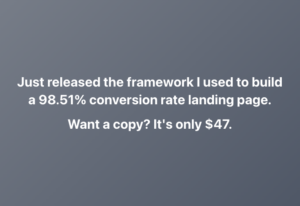
It's not a lie if it only works for some businesses. It's a half-truth. We have all been fed these meals when it comes to sales and marketing. Today I want to explore some of those “Impossible” half-truths that often hamper our success when marketing our businesses online. These include:
- Cookie Cutter Competition
- Your Website Is A Bro (sure)
- Traffic Trumps Trust
- Ads Add Profits
- Social Media Sells
Cookie Cutter Competition
 All too often, solution providers promote a one size fits all solution. If it works for companies A, B, & C, it will surely work for YOU, too! It sounds appealing, but how do you know if all companies had the same experience or the same results? Honestly, you DON'T!
I have found that every company has its unique personality and challenges. Often simple solutions will solve simple problems. However, companies face complex challenges. For my clients, these challenges are usually a combination of marketing, sales, IT, and more.
Cookie Cutter Solutions will do one thing well but often fall short because other issues still have to be solved in order for a client to achieve real and sustained success.
Your Website Is A Bro (sure)
 “Dude (or Dudette)… your website rocks.” Sure, we all love to hear that, but there is a big difference between a good website and an effective website. Often the best-looking websites are created by designers. They have a great eye and design sense. However, their skillset has often been built around print design. Although that can translate well to a website, it lacks some of the core marketing and technological systems a bigger B2b company needs.
Images and words can tell a compelling story. A truly effective website has one goal that is often overlooked in a brochure-style site. The main goal of a B2b website is to start and maintain conversations between your salespeople, and clients or prospects.
B2b websites need to be more than just a Bro(sure). It's a combination of a brochure, information distribution platform, resource library, lead capture system, and a company relationship ecosystem. This can be tracked to sales and profits when you have the right systems and measurement tools in place.
Traffic Turns Into Trust
 Many consultants and agencies measure success on what they know and do best. This often includes driving visitors to your website, adding people to email lists, and building communities on social media. This all sounds great to most business owners because the more eyes and ears you get in front of should translate to more sales. But does it really?
B2b business is a long game. Relationships can take months (or years in some cases) to turn a website visit into a closed deal. To that point, it's quality, not quantity that counts. Think about it. More traffic may drum up more leads, but how many of those people are just tire kickers and price shoppers? That can take quality time away from building and maintaining current sales relationships.
Most businesses would be happy with 2 to 10 new quality business relationships per month. Especially when they start with a small order that leads to a medium order, and then a huge order. That takes time, engaging in conversations, and building trust. Every ten quality connections could lead to 2-4 mid-sized and 1-2 huge orders in the course of a year. So should you be focusing on 10,000 visitors, or ten quality sales conversations per month?
Ads Add Profits
 Advertising and SEO are focused on getting more eyes on your website. If you read the last three points, you can see that can be an enticing trap. Once you understand that search engines and social media platforms are not public services it makes even less sense. Those are all advertising platforms (that's how they make their money… and LOTS of it!)
Google does not necessarily serve your ads to people who could or would buy from you. They serve up ads based on what people put in the search bar. That includes a wide variety of possibilities. SEO helps cut down on the need for ads, but the audience is the same.
Social media platforms have much better demographic capabilities. But once again, you cannot control who actually sees (and ultimately acts) on those ads. Also, advertising a B2b business on a platform like Facebook, Instagram, TikTok, and others is hard. People visit those platforms for fun and entertainment. Unless you are selling direct to consumers, Linkedin is the only real player in advertising for the B2b business space.
Social Media Sells
 To build on the point above, social media can create awareness for your business, but there is a BIG difference between social media and social networking. Many companies try to compete in the social media game by creating business-only pages or creating community groups. Unless you are buying ads for that content, very few people will ever see it. Again, these social media platforms are in the advertising business.
Real success in social media comes through social networking. This is a one-to-one relationship between your salespeople and your current and prospective customers. The big challenge here is getting all your salespeople to consistently share the same information at the same time.
That is important because even on personal profiles, only about an average of 150 people will see what you post (no matter how many connections you may have). By getting ten people to post the same information at the same time, you create a potential of 1500 people seeing and interacting with your business content.
Final Thoughts
 Don't feel bad if you have fallen for any or all of the above half-truths. I have fallen for ALL of them at one time or another. I have learned those lessons through my own business first and then through trial and error with many of my clients. It's taken years to build a system that is not only repeatable but flexible enough that it can adapt to each business's individual complexities and challenges.
I know for a fact that it's not going to work for every business, but it's not “Impossible”. That is why we have deep conversations before ever creating and distributing a single piece of meat (content). When it is a good fit, companies are seeing a 10x to 15x ROI in generating new business sales. It takes time, and commitment (like any business relationship), but it's “possible.” Knowing the whole truth can help you taste success for yourself!
“A lie gets halfway around the world before the truth has a chance to get its pants on.”
– Winston Churchill
Comment below and share your thoughts, ideas, or questions about half-truths in B2b sales and marketing.
To learn more about this and other topics on B2b Sales & Marketing, visit our podcast website at The Bacon Podcast.

