I find myself using AI more and more in business.
It can be both a time saver and a time suck. For example, I recently had a technical problem with my Mac trying to connect my RING cameras to my home. I used Perplexity to guide me through troubleshooting steps. It was helpful, but it led me down some technical rabbit holes that ended up eating an entire day without any successful conclusion.
I’m really committed to getting this to work, but I’m both amazed and a bit let down by how AI handles tech support. I was trying to get help from my ISP (Spectrum), and it led me on a long journey, eventually getting me to chat with a real person. After an hour of back and forth, I still didn’t get the answers I needed.
AI Writing
Almost every operating system and tool has an AI assistant. I rarely use them to write my content, but I will ask them to rewrite a paragraph or two when I feel my original text is a bit disjointed.
I subscribe to Grammarly annually. It helps me with my poor spelling and corrects some of my grammar when I am trying to dump thoughts with my two-finger typing!
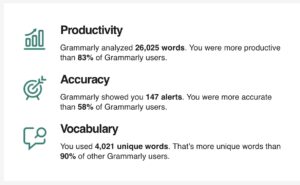
Grammarly sends me a report every week that gives me feedback about my use of it (another AI-powered writing assistant).
It grades me on accuracy, words used, and more. While it's great for my ego, it's also easier than most tools since it reads and corrects your typing in (close to) real-time.
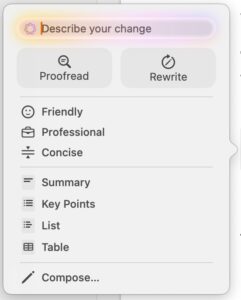 On a Mac, Apple's AI assistant is available in every program where typing is a thing. While in the program, just right-click and select Show Writing tools, and it brings up a menu. (Or you can go to Edit > Writing Tools > Show Writing Tools to get the same thing.)
Apple’s Writing Tools can rewrite your words in three tones—Friendly, Professional, and Concise—almost everywhere you type. Think of them as three different “marketing personalities” you can switch on or off, depending on who you’re talking to and what you’re trying to achieve.
That got me thinking about my marketing style.
Marketing Styles
 I tend to market my business in a friendly, collaborative, and more informal style. I tend to use stories, metaphors, colorful language, and visual imagery.
As a marketing agency, that works for me, but each of my clients has their own style. Our job as a team is to replicate our clients' style and voice. And, let me assure you, everyone I work with is vastly different.
So, using the Apple model, I thought I would explore the three different styles. And, just like a DISC profile is really just a D, I, S, or C, there can be variations based on the audience you are talking with.
I believe that the tone should match the audience.
- If your audience is a D (Direct), your voice could be more Concise with a Summary.
- If your audience is an I (Influencer), your voice could be more Friendly.
- If your audience is a S (Steady), your voice could be more Professional.
- If your audience is a C (Conscientious), your voice could be more Bulleted with Key Points.
I think the tough part we all need to figure out is which style speaks to the largest possible group we are trying to get our message to. And then we need to stick to that style as often as possible.
Let's look at some ideas for how you can use the three main styles to get your messages to resonate better.
The Friendly Marketer
 The Friendly tone feels like chatting with a smart, helpful friend over coffee. It’s casual, conversational, and designed to close the distance between your brand and your audience.
What it sounds like:
- “Hey there! Let’s walk through this together.”
- “Here’s a quick tip to make your day easier.”
- “Got questions? We’ve got your back.”
Where it shines:
- Social media posts and comments
- Newsletters and nurture sequences
- Onboarding emails and in‑app messages
Why it works: A friendly marketing style builds trust and approachability, which is perfect when you want people to feel seen, supported, and welcome. If your brand lives on relationships and long‑term loyalty, this is your home base.
The Professional Marketer
 The Professional tone is confident, clear, and polished without being stiff. It respects your reader’s time, uses straightforward language, and focuses on outcomes and value.
What it sounds like:
- “Here’s our plan and what you can expect next.”
- “This solution helps your team save time and reduce costs.”
- “We appreciate your partnership and look forward to continuing our work together.”
Where it shines:
- Proposals and pitches
- Executive summaries and board updates
- Client reports, case studies, and LinkedIn posts
Why it works: A professional marketing style signals credibility and reliability, which is essential when decisions involve budgets, risk, or complex solutions. It says, “You can trust us with important things” without needing fancy jargon.
The Concise Marketer
 The Concise tone is your inner editor with a timer and a red pen. It trims the fluff, gets to the point, and makes every word earn its place.
What it sounds like:
- “Here’s what changed and what you need to do.”
- “Three benefits: faster setup, lower costs, better results.”
- “Next steps: schedule a demo, choose a plan, launch.”
Where it shines:
- Subject lines and headlines
- Calls‑to‑action and landing page copy
- Internal updates, release notes, and product change logs
Why it works: A concise marketing style respects the reality that everyone is busy and drowning in content. When you make it effortless to understand the “what” and “why,” more people actually take action.
How to Find Your Default Style
 You probably have a “default” tone you slip into without thinking—just like Apple’s tools, you’re naturally more Friendly, Professional, or Concise. The trick is to know your default and then intentionally “switch styles” when the audience or context changes.
Ask yourself:
- When I write quickly, do I sound more warm, polished, or straight‑to‑the‑point?
- Do people compliment me more on being relatable, credible, or clear?
- Where do I get the best engagement—social posts, formal content, or punchy snippets?
Your answers will tell you which marketing style is most “you,” and which ones you might want to practice using Apple’s Friendly, Professional, and Concise rewrites as training wheels.
Using All Three Like a Pro
 The real power move is not picking one style forever, but learning when to toggle between them.
Try this simple combo:
- Start Friendly to hook attention and build a connection.
- Shift to Professional to explain value and build trust.
- Finish with a Concise, clear, action‑driven next step.
Example flow:
“Hey there! We know managing your marketing pipeline can feel overwhelming.” [Friendly]
“Our platform helps teams streamline campaigns, improve reporting, and make data‑driven decisions without adding extra workload.” [Professional]
“Book a 20‑minute demo to see it in action this week.” [Concise]
You may or may not like that style example, but it's up to you to fill in the blanks with your or your clients' voice that matches the audience(s) being addressed.
When you can move smoothly between Friendly, Professional, and Concise, your marketing stops sounding generic and starts sounding intentional, confident, and uniquely you.
Closing Thought
 AI can definitely help you write more easily, but it might also make your writing sound a bit too common. Or it can sometimes make your writing sound a bit more verbose and full of technical terms. (That sentence was rewritten with a friendly tone.)
The utilization of artificial intelligence (AI) to assist you is undoubtedly advantageous. However, it is imperative to ensure that the AI-generated content is appropriately prompted or revised to align with the distinctive voice and style of your business, as well as the target audience you intend to reach with your business’s unique voice and style. (That sentence was rewritten with a professional tone.)
The key to success is letting AI act as an arch support, and not a crutch, when it comes to getting your messages across in a way that informs, entertains, and creates action. Here is the concise version: Let AI support, not replace, your efforts to convey informative, entertaining, and action-inspiring messages.
Be yourself—because people can smell AI a mile away. Em dashes—a telltale sign that AI has its two fingers around your marketing copy!
______________________________
Comment below and share your thoughts, ideas, or questions about business-to-business sales and marketing today! Do you have a sales or marketing communications strategy that works for you? What tips or techniques can you share that work for you and your business?
To learn more about this and other topics on B2b Sales & Marketing, visit our podcast website at The Bacon Podcast.